

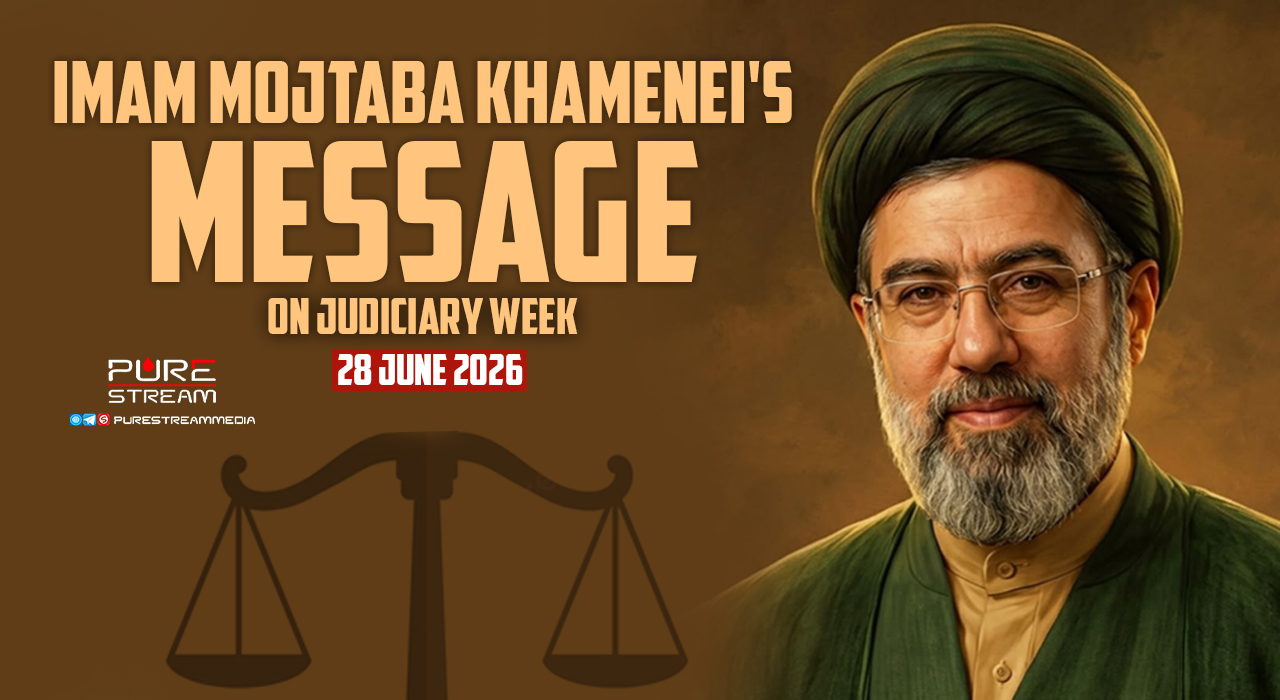
Imam Mojtaba Khamenei’s Message on Judiciary Week
In the Name of Allah, the Most Compassionate, the Most Merciful.
I extend my condolences to the people of Iran and the entire Islamic Ummah on the days of mourning for the Alullah (referring to the Ahl al-Bayt (A)) and the martyrdom of hazrat Tharullah Imam Husayn (A), and his loyal companions.
The movement and uprising of Imam Husayn (A), undertaken to establish Truth, to reform the Muslim Ummah, and to confront oppression and injustice, stands as the highest peak in the history of the struggle between Truth and falsehood, and justice and tyranny.
It offers invaluable and unforgettable lessons for all the free people of the world. The blood of Sayyid al-Shuhada (the Master of Martyrs) [Imam Husayn (A)] is called the “Blood of Allah” (Tharullah), which flows through the veins of the world and gives rise to life-giving epics.
Since the Islamic Movement and Revolution of Iran is a branch drawn from this luminous source, it must always strive to achieve the objectives of the Husayni uprising.
Each year, the seventh of Tir (June 28th) recalls the distinguished revolutionary figure (Shaheed Beheshti) who, upon assuming the leadership of the Judiciary branch, pursued these goals with unwavering effort until he, together with a group of sincere companions of the [Islamic] Revolution, drank [from] the honey of martyrdom. His suffering oppression, together with the seventy-two martyrs [who were martyred with him], became a testament to the Husayni character of this [Islamic] system and its architects.
The position of the Judiciary branch in the Islamic Republic of Iran is to protect the rights of the people, to restore public rights and lawful freedoms, to combat corruption, to administer justice, to establish Allah’s Hudood (divinely prescribed legal limits), and to supervise the implementation of the law.
The fruits of success in this path – along with earning Allah’s satisfaction – strengthens public trust in this pillar of the [Islamic] system.
It is the rightful expected from all branches [of the government], institutions, and responsible bodies that they continually align and reform their performance according to the desirable standards of the sacred system of the Islamic Republic and the lofty dignity of the nation.
In this regard, the Judiciary branch occupies a unique, and indeed unparalleled position in reforming the course of affairs and setting other sectors of the [Islamic] system in motion. This also requires following up on the procedure of reform and reconstruction within the Judiciary branch itself.
Today, the general public expects to witness practical commitments to these principles in the Judiciary’s performance. In a manner where, the Judicial branch’s transformation should move beyond the words written in reform documents, strategic plans, and roadmaps, and become a tangible reality.
Its effects should be visible in every relevant sphere, from judicial complexes and courtrooms to public spaces and society at large. To the point where people should experience its positive impact in their daily lives through firm action against all forms of corruption, the reduction of the violations of rights, faster judicial proceedings, improved integrity and soundness of judges’ rulings, and easier access to the standards of justice.
In this vision of the Judiciary branch, justice must reach such a level that every oppressed person regards the Judiciary branch as a safe haven, and [justice must reach a level where] especially those who possess some sort of power do not dare violate the rights of others; and the practice of favoritism and personal recommendations must be completely eliminated, and having acquaintances within parts of the Judiciary branch cannot confer an advantage whatsoever.
Of course, protecting the rights of the nation is not limited to individual matters. Public and social rights; from the right to economic security, the right to the fair access of opportunities, to the right of the equitable enjoyment of natural resources, [the right to] a healthy environment, [the right to] lawful freedoms, and [the right to] effective governance, are also among the essential elements of expanding justice.
Among the most important legal and judicial issues facing the entire Iranian nation at this time is the pursuit and restoration of the rights that have been violated as a result of the crimes committed by international criminals, the Arrogant Powers, and global aggressors, particularly during the years 2025-2026.
From the blood of the innocent martyrs of the Second and Third Imposed Wars, to the physical, psychological, material, and spiritual injuries and damages inflicted upon our beloved country and upon every member of the oppressed Iranian nation, both inside and even outside the country.
From the killing of children and unprecedented war crimes in Minab and Lamerd, to attacks on medical and public service centers.
From the killing of newborn infants only a few days old to beloved elderly citizens.
And above all, the martyrdom of the unparalleled personality, the incomparable and unique gem of the era, the greatly honorable Mujahid leader [Shaheed Khamenei], may Allah elevate his noble station.
Each of these constitutes one among hundreds – indeed thousands – of significant legal cases that must be pursued seriously in both domestic and international courts.
What is certain is that the perpetrators of these crimes must be brought to justice and punished for their criminal actions.
An important point in this regard is the admission of some of the leaders of the American and Zionist enemy themselves to committing these [criminal] acts, and [at times,] even shamelessly boasting about it. Such statements undoubtedly constitute admissions of criminal conduct and provide a substantial basis for pursuing and restoring the violated rights of the Iranian nation [in a court of law].
Secondly, focusing on and implementing the directive issued by the Martyred Leader of the [Islamic] Revolution during his final meeting with judicial officials in [the month of] Tir of last year concerning the investigation of the crimes committed during the Second Imposed War necessarily requires extending that effort to include the Third Imposed War as well, and continuously pursuing these cases until judicial rulings are obtained and their enforcement is entrusted to the appropriate authorities. Such action will, in turn, help prevent the recurrence of crimes of this nature [in the future].
Of course, in order to gain the grace for the success in achieving comprehensive judicial transformation and accelerating progress toward the aforementioned objectives requires a variety of preparations and prerequisites.
These have – for the most part – been repeatedly outlined during the annual meetings with judicial officials and in the extensive recommendations and detailed guidance of the greatly honorable Martyred Leader, may Allah elevate his pure soul.
Paying serious attention to these recommendations and dedicating efforts to realize them – which are regarded as the key to the success of the Judiciary branch’s respected officials – are [strongly] emphasized and seriously expected by me.
The path to reach justice and the struggle against oppression and corruption is a difficult one.
It can be made smoother through Ikhlas (sincerity) and Tawakkul (reliance on Allah), adhering to the highest degree of Taqwa (piety), motivation and firm determination, double the effort and struggle, courage and decisiveness, innovative action, and the proper use of modern technologies and intelligent systems.
The realization of all of these goals will – by Allah’s permission and under the blessings of his eminence the Awaited Justice, our Master [Imam al-Mahdi (A)], may Allah the Exalted hasten his noble reappearance – be made possible, Insha Allah.
Sayyid Mojtaba Husayni Khamenei
7 Tir 1405
28 June 2026